


Maa Baglamukhi Navratri Special Anushthan
Seasonal devotion dedicated to Maa Baglamukhi during Chaitra and Sharadiya Navratri. Understand daily disciplines, attendance options, and transparent arrangements at Nalkheda.
Season, dates, ritual elements, officiants, and dakshina are confirmed in consultation.
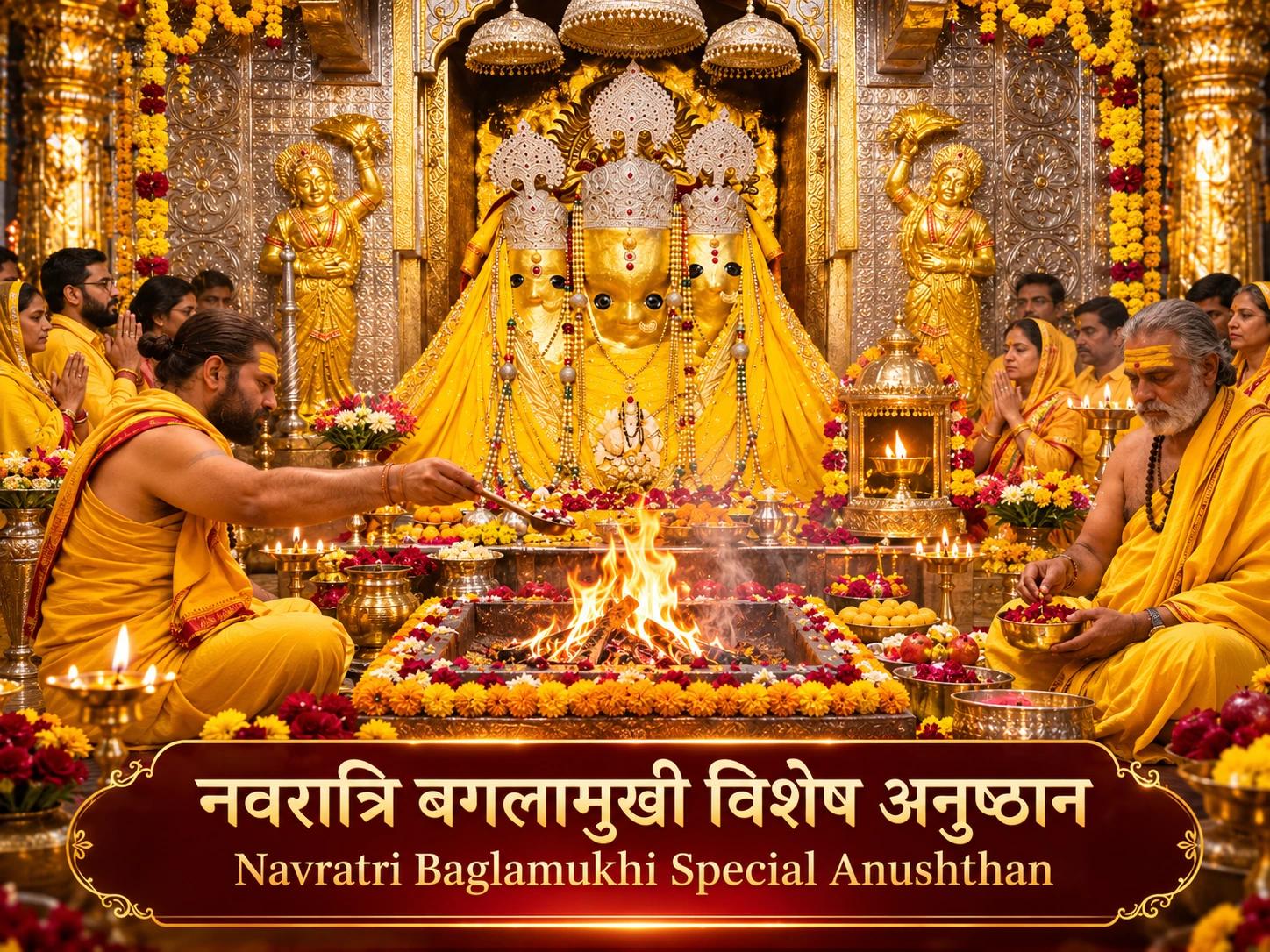
Nine Days That Ask a Different Question
The first thing that changes during Navratri is often not the temple. It is the household. Someone sets aside a small prayer space. A familiar lamp is lit with extra care. A person who normally rushes through the morning makes time to sit quietly for a few minutes. Another keeps a fast according to family custom; someone else cannot fast and chooses a simpler form of prayer. Across these different lives runs a shared intention: for a little while, devotion should receive more than the leftover minutes of the day.
That is why Navratri is meaningful even before we discuss an anushthan. Its name is commonly understood as “nine nights.” In widely observed forms, it is a period dedicated to the Divine Mother, with practices that differ according to region, lineage, household and the season. The calendar, the form of worship and the language of prayer may vary. The effort to make one’s attention more deliberate is something many devotees recognise.
At Nalkheda, visitors come to the Maa Baglamukhi temple with their own questions. Some are carrying family responsibilities. Some are dealing with pressure at work. Others want to pray in gratitude, or feel that the festival is the right time to renew a neglected practice. This guide is for them: not to tell them which result to expect, but to help them understand what they are asking about before they make an arrangement.
Chaitra and Sharadiya: The Same Devotion, Different Seasons
Chaitra Navratri falls in the spring season of the Hindu calendar and is often closely associated with new beginnings and, in many traditions, Ram Navami. Sharadiya Navratri falls in the autumn and is widely observed with forms of Devi worship that include Durga Puja and Vijayadashami-related celebrations. Regional customs can be quite different, even when households use the same word, Navratri.
Observed from Chaitra Shukla Pratipada to Navami (March–April). Marks the traditional Hindu New Year and Ram Navami. Malwa weather begins to warm up; planning visits around cooler morning hours is advisable.
Observed during Ashwin month (September–October) culminating in Vijayadashami. Nationwide Devi celebration with peak pilgrim footfall at Nalkheda. Early lodging and transportation arrangements are strongly advised.
A devotee planning a trip to Nalkheda should not assume identical schedules for both seasons. Tithi variations mean festival days may not map 1:1 to Gregorian dates. Always confirm confirmed calendar dates rather than generic tithi estimates.
Why Maa Baglamukhi Enters a Devotee’s Navratri Prayers
In Shakta devotional traditions, Maa Baglamukhi is associated with the symbolism of stillness and the restraint of harmful speech. Her worship can be understood by a devotee as a prayer for steadiness when words have become aggressive, judgments are difficult, or the mind is scattered by conflict. These are religious associations, not scientific proof that a ceremony can control other people or decide an external event.
During Navratri, that symbolism can become part of a wider question: What do I need to stop feeding with my attention? Perhaps it is anger that makes a disagreement worse. Perhaps it is the habit of anticipating every possible setback. Perhaps the devotee simply wishes to build a more regular relationship with prayer. Different people find their own language for it.
The festival need not be reduced to a list of problems. Gratitude, remembrance and ordinary love for the Goddess are equally valid reasons to participate.
The Difficulties Devotees Bring — And What Honest Guidance Sounds Like
Understanding faith requires that we neither dismiss personal distress nor offer hollow miraculous promises:
When a household has been arguing for months, a person may seek a shared sankalp for peace. Prayer can be meaningful alongside real conversations, boundaries and family counselling. Avoid claims that ritual instantly changes another’s behavior.
A devotee might pray for calm speech and clearer judgment. If there is harassment or contractual breach, preserve evidence and use appropriate formal channels. Ritual is not an alternative to protecting rights.
Visitors choose a festive observance to mark hope and renewed responsibility. No puja can guarantee contracts or financial windfalls; sound business planning and due diligence remain essential.
A household may wish to begin a demanding academic or professional period with prayer. Spiritual comfort does not replace revision, mentoring, or disciplined effort.
The rhythm of worship brings spiritual comfort. Persistent sleep difficulties, panic, or clinical symptoms deserve qualified medical attention alongside spiritual practice.
Not every visit begins with distress. Many devotees pray because the festival is sacred to their ancestors or because the year brought something worth thanking the Divine Mother for.
What an Anushthan May Look Like — Without Pretending to Know Your Booking
A thoughtfully explained arrangement starts with a conversation, not a payment screen. The organiser should first clarify which form of worship is requested and which parts are actually available:
Sankalp & Devotional Intention
Identification of the devotee/family by gotra and location. Devotional intentions are spoken with solemnity; personal privacy must be respected.
Preliminary Worship & Kalash (If Agreed)
Traditional invocation of Ganesha, Navagrahas, and Maa Baglamukhi. Akhand Deep or special Kalash Sthapana must be specifically confirmed, not assumed.
Daily Mantra Japa or Recitation
Prescribed Baglamukhi mantra japa or stotra recitation. Ask how many sessions take place daily and whether the devotee participates in person.
Concluding Havan & Purnahuti (If Booked)
A sacred fire rite concluding the sadhana, typically on Durgashtami or Maha Navami. Clarify whether havan samagri and wood costs are included.
Aarti, Prasad & Respectful Conclusion
Final prayer, respectful honorarium to officiants, and distribution of dry prasad. Courier realities for remote devotees must be checked.
What to Prepare Before Visiting Nalkheda
The Agar Malwa district government’s temple description identifies the shrine on the banks of the Lakhundar River in Nalkheda; that verifies the temple’s location, not the exact venue of any private service. Prepare with practical clarity:
Crowds are multi-fold during Navratri. Allow substantial buffer time for temple darshan queues, vehicle parking, and moving between locations.
Modest, clean traditional clothing. Yellow garments are customary in Baglamukhi traditions, but check whether specific colours are required for your rite.
Ask about steps, smoke exposure near fire pits, waiting areas, and accessible seating if accompanying senior citizens or young children.
Those with diabetes, pregnancy, or medical regimens should not undertake severe fasting without clinical approval. Devotion prioritizes safety and mindfulness.
If You Cannot Travel: What Should You Ask?
A remote sankalp is not automatically included in a Navratri listing. Before making any payment, check whether the named organiser actually offers remote participation, what proof of the ritual will be provided, and how personal details are protected:
How Navratri Special Anushthan Compares to Other Approved Pujas
Each of the 14 approved services at Nalkheda has distinct focus and ritual structure. Use this table to understand the boundaries before booking:
| Offering | Main Distinction | Ask Before Choosing |
|---|---|---|
| Navratri Special Anushthan | Festival-timed focus on Maa Baglamukhi; structure varies | Is it one day or several? Which dates and specific rites? |
| Puja & Special Archana | Direct worship/archana; not necessarily a festival observance | What does the selected archana include? |
| Maa Baglamukhi Havan | Fire-offering-focused ritual with samagri & ahutis | Is Havan part of the chosen Navratri arrangement? |
| Maa Baglamukhi Mantra Jaap | Focus on recitation counts (e.g. 11,000 / 21,000) | What recitation is proposed, and by how many pandits? |
| Sawa Lakh Mantra Anushthan | Specific extended count of 1,25,000 recitations | Is this count included or a completely separate observance? |
| Navchandi Path & Havan | Focus on Chandi/Durga Saptashati text and associated fire rite | Is there any link to Navratri scheduling, or a separate booking? |
Fees, Receipts, and the 8-Point Pre-Booking Checklist
Clear Separation from Temple Trust Administration
An independent devotional or travel platform must never imply that its consultation form is an official temple trust reservation. The district administration points users toward the temple’s official channels for administrative matters. A consultation service and any temple-administered charges are distinct.
The recurring claim of a mandatory ₹350 statutory token must not be published as fact without current documentary verification. Devotees deserve itemized clarity.
8 Questions to Confirm Before Any Commitment:
Ask About Navratri Arrangements
Share your preferred season, approximate dates, and family participation needs. We will explain what is currently known and what still requires confirmation with qualified local organisers.
No published experiences for this observance yet. If you participated, sign in to share an honest account. A login proves your account, not attendance; verified participation is marked only after a completed booking is independently matched.
Researched Inquiries & Frequently Asked Questions
It is an observance focused on Maa Baglamukhi during a Navratri period. Anushthan describes disciplined worship, but the exact prayer, mantra, duration, officiants and whether Havan is included must be confirmed for the specific arrangement.
Experiences Shared by Devotees
Authentic reflections shared by devotees who performed or participated in Maa Baglamukhi Navratri Special Anushthan.
Be the First Devotee to Share Your Experience
No reviews have been published for this ritual yet. TIRTH YATRA strictly shows genuine user submissions and never manufactures ratings.
Agamic Sources & Related Offerings
Plan Your Sacred Ceremony with Verified Acharyas
Receive traditional guidance from verified Nalkheda purohits. Clarify auspicious muhurta, samagri, and participation arrangements with complete transparency.