


Maa Baglamukhi Sawa Lakh Mantra Anushthan
One prayer, repeated patiently over time. Understand what the 1,25,000 number means, how the observance is organised, and what to ask before arranging anushthan.
Recitation count, schedule, practitioner allocation, participation and dakshina are confirmed after initial enquiry.
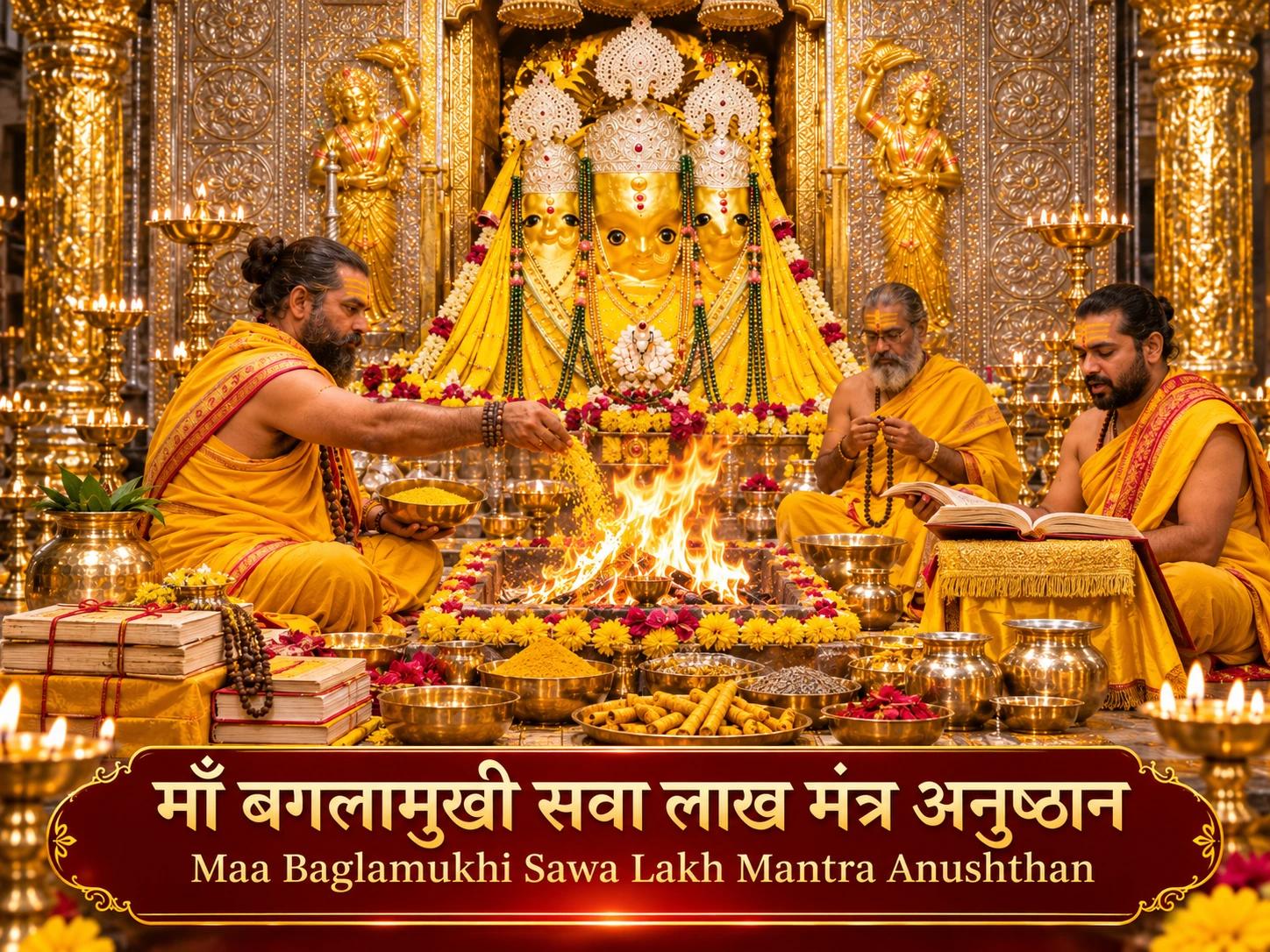
What Would It Mean to Return to One Prayer 1,25,000 Times?
A person can repeat a sentence without hearing it. We do it with names, passwords, familiar greetings, and words we have used for years. Prayer asks for a different relationship with repetition. Instead of trying to finish as fast as possible, the idea is to return—again and again—to something that holds meaning.
That is the starting point for understanding a Sawa Lakh Mantra Anushthan. Sawa lakh means one lakh and twenty-five thousand: 1,25,000. Mantra jaap refers to repeated recitation of a sacred formula or divine name. Anushthan suggests a more deliberately organised observance, often with an agreed sankalp, a defined discipline and a way of keeping track of progress. Different lineages and organisers may use these words in somewhat different ways. The name alone does not tell you the complete procedure.
If a family is considering this observance in connection with Maa Baglamukhi at Nalkheda, the sensible first step is not to select the biggest package on a screen. It is to understand what will be done, who will do it, what your own participation looks like, and what will happen if dates or arrangements change. These questions make devotion more thoughtful, not less sacred.
Why the Number Matters — And Why Counting Is Not the Whole Story
A lakh is 100,000. Sawa lakh adds another quarter lakh, making 125,000. Large recitation totals appear in a number of Hindu devotional and practitioner traditions, although their precise meanings and procedures vary. Scholarship on japa points out that repetition has taken different forms across Vedic and later devotional settings. It is a mistake to treat every kind of jaap as one uniform ritual.
Some practitioners use a mala to follow repetitions. The beads provide a consistent way to count without constantly looking at a device. But a total should never be treated as a vending-machine code—enter 125,000 repetitions and receive a guaranteed court judgment, business contract or change in another person's behaviour. Such a promise has no defensible basis.
The target becomes meaningful only within a carefully explained observance. Ask which mantra is intended, whether any guidance or initiation is required within that tradition, whether the count is performed by one practitioner or several, how the tally is recorded and what marks its conclusion.
As an arithmetic illustration, 1,25,000 divided by 108 equals 1,157 full 108-count rounds with 44 repetitions remaining. Counting conventions vary across traditions; this is educational context, not a universal prescription.
Why Maa Baglamukhi Enters This Conversation
Maa Baglamukhi is worshipped within Shakta traditions and is often associated with stambhana, a word commonly understood in the language of restraint or stilling. In popular conversation this can quickly become an exaggerated claim about controlling opponents. A more responsible explanation is that devotees bring different personal intentions to the Goddess: courage during conflict, steadiness in uncertainty, or the wish to respond with greater care when life feels pressured.
This distinction matters most when someone is vulnerable. If you have a legal dispute, your documents and lawyer still matter. If family conversations have become painful, listening and boundaries still matter. If you are waiting for career news, continuing practical effort still matters. A devotional observance may hold spiritual meaning within your faith, but it cannot replace the actions that help a real situation change.
Nor is a difficult problem a requirement. Some devotees wish to offer an extended observance simply as an expression of reverence. The page should make room for that quiet, non-commercial reason too.
Nalkheda: A Place of Worship, Not a Shortcut Around Verification
The Maa Baglamukhi temple is in Nalkheda, Agar Malwa district, Madhya Pradesh, near the Lakhundar River. The district's government listing describes the shrine and points to the temple's own website. It also recounts a traditional association with Yudhishthira and Krishna. That story belongs in the realm of local religious tradition; it should not be presented as an excavated or dated historical fact.
The temple location is a verified fact. A specific 1,25,000-jaap service package is a different claim. The district page does not confirm that an independent platform may book the rite in the sanctum, assign priests, guarantee recording, or charge an official temple fee. Before you plan travel, ask the organiser to identify the actual venue and their relationship with the temple administration. The phrase “at Nalkheda” is not automatically the same as “officially run by the temple.”
Maa Baglamukhi Temple on Lakhundar River, Agar Malwa, MP
Independent priest coordination; not an official temple package
Sankalp: Giving an Intention Its Proper Place
Before a devotional observance, the word sankalp often comes up. In simple terms, it is a statement of intention: the person or family for whom the observance is undertaken, and the purpose for which they wish to pray. Some arrangements request a name and gotra. Other details depend on the tradition being followed and the organiser's actual procedure.
A devotee should not feel pressured to disclose every intimate difficulty just to ask for a price or a date. It is reasonable to describe the intention broadly—family well-being, devotion, mental steadiness, an important life transition—and share more only with an appropriately trusted practitioner when genuinely needed. Personal details should be handled privately, not displayed in public testimonials or booking screenshots.
Anushthan is sometimes described as a discipline, and that is a useful word. A discipline has a beginning, a pattern, and a conclusion. It also needs patience with ordinary human circumstances. If a day must change or a family member cannot attend, the organiser should explain how the plan adapts rather than making the devotee anxious about having “broken” an invisible guarantee.
What an Extended Observance May Involve: 4 Practical Stages
Initial Alignment & Tradition
Confirm the offering name, 1,25,000 count scope, responsible officiant, mantra lineage, and written service agreement.
Agreed Sankalp & Data Privacy
Devotee intention clarified. Only necessary gotra and family details collected, stored securely without public exposure.
Recitation Period & Tally Verification
Understand whether recitations are shared among officiants or joined by the family, and how daily completion is logged.
Completion & Concluding Observances
Any closing havan, tarpan, or completion prayer must be explicitly confirmed in writing, with separate itemization if applicable.
Life Situations People Often Bring to the Conversation
Seeking composure during protracted hostility. Devotion aids mental stillness; legal and professional steps remain essential.
Undertaking an observance for family welfare during major milestones or collective transitions.
Prayer provides inner fortitude during demanding career periods, but cannot substitute for sound financial planning.
A seeker drawn to sustained sacred practice without expecting a dramatic external return. Faith and devotion on their own terms.
Frightened seekers deserve greater transparency, not sales pressure. Take time, ask clear questions, and avoid panic-driven bookings.
Imagine a household facing multiple uncertainties at once: career decisions, a long dispute, and daily friction. A helpful guide does not claim a bigger recitation count will automatically dissolve all worries. It explains the differences between simple archana, everyday jaap, and an extended 1,25,000-count observance, empowering the family to choose thoughtfully.
(Illustrative scenario, not a claim of guaranteed results)
Ordinary Mantra Jaap vs Sawa Lakh Anushthan vs Other Offerings
| Approved Ritual | Core Focus | Scope / Scale | Key Distinction |
|---|---|---|---|
| Sawa Lakh Mantra Anushthan (This Page) | Extended 1,25,000 recitation target across confirmed days | 1,25,000 count; closing rites confirmed separately | Extended discipline; scope requires written alignment |
| Maa Baglamukhi Mantra Jaap | Sacred sound remembrance, focus and quiet repetition | Standard scope (e.g. 11,000 or 24,000 recitations) | Accessible prayer; should not be automatically upsold |
| Maa Baglamukhi Havan | Fire offerings with sacred wood, ghee & herbal samagri | Traditional fire oblations & family sankalp | Fire-centric rite; not identical to plain mantra jaap |
| Maa Baglamukhi Puja & Special Archana | Sixteen-offering worship (Shodashopachara) & stotra recital | Devotional temple offerings session | Direct offerings rather than extensive count tracking |
For legal-dispute specific devotional prayers, consult the Court Case Victory Puja page. For prosperity-focused offerings, see Dhan Lakshmi Prapti Puja. Note: Legacy "Maha Anushthan" package labels are now retired; relevant count guidance is consolidated here transparently.
Count and Time: Two Different Questions
People often ask how many days 1,25,000 repetitions take. There is no defensible universal answer without knowing the mantra, recitation style, number of practitioners, daily schedule and associated practices. A person can calculate arithmetic totals, but those totals should not become ritual instructions or a sales promise.
If a provider offers a completion date, ask how it was determined and whether the schedule appears in the written arrangement. The same caution applies to how many priests are involved. Priest counts should reflect real availability and agreed roles; invented tiers are not evidence of quality.
What can this observance honestly promise? Only what the provider has actually agreed to deliver: a specific devotional service, within defined dates, conditions and scope. It cannot promise control over others, court wins, election triumphs, or medical cures.
Before You Enquire, Prepare Six Clear Questions
Who is responsible for the jaap?
Ask about the practitioner’s background, lineage, and experience.
Is the 1,25,000 count in writing?
Ensure the count target and recordkeeping method are explicitly documented.
Which mantra & preparation rules apply?
Clarify initiation, dietary, and traditional conduct guidelines.
What will I or my family actually do?
Understand required attendance, participation hours, and sankalp role.
Where & when will the rite take place?
Verify the physical venue and the coordinator’s relationship with the temple.
What is the full itemized cost?
Request an itemized quotation covering reciters, samagri, and closing rites.
A Thoughtful Way to Begin
If the idea of Sawa Lakh Mantra Anushthan speaks to you, begin with an enquiry, not an assumption. Ask how the tradition is followed, who will guide it, and what the recitation total entails before making any commitment.
TIRTH YATRA is an independent pilgrimage information platform.
Researched Inquiries & Frequently Asked Questions
It means an organised devotional observance centred on a stated total of 1,25,000 mantra repetitions. The expression describes the intended scale, not a complete, universal procedure. Ask the actual organiser which mantra tradition, schedule, personnel, recordkeeping and closing practices apply.
Experiences Shared by Devotees
Authentic reflections shared by devotees who performed or participated in Maa Baglamukhi Sawa Lakh Mantra Anushthan.
Be the First Devotee to Share Your Experience
No reviews have been published for this ritual yet. TIRTH YATRA strictly shows genuine user submissions and never manufactures ratings.
Agamic Sources & Related Offerings
Plan Your Sacred Ceremony with Verified Acharyas
Receive traditional guidance from verified Nalkheda purohits. Clarify auspicious muhurta, samagri, and participation arrangements with complete transparency.