


Maa Baglamukhi Mantra Jaap
Not every prayer begins with a fire ritual. Learn what Maa Baglamukhi Mantra Jaap involves, how sankalp and mala counting work, and what to ask before arranging jaap.
Recitation count, schedule, participation, practitioner and charges confirmed in consultation.
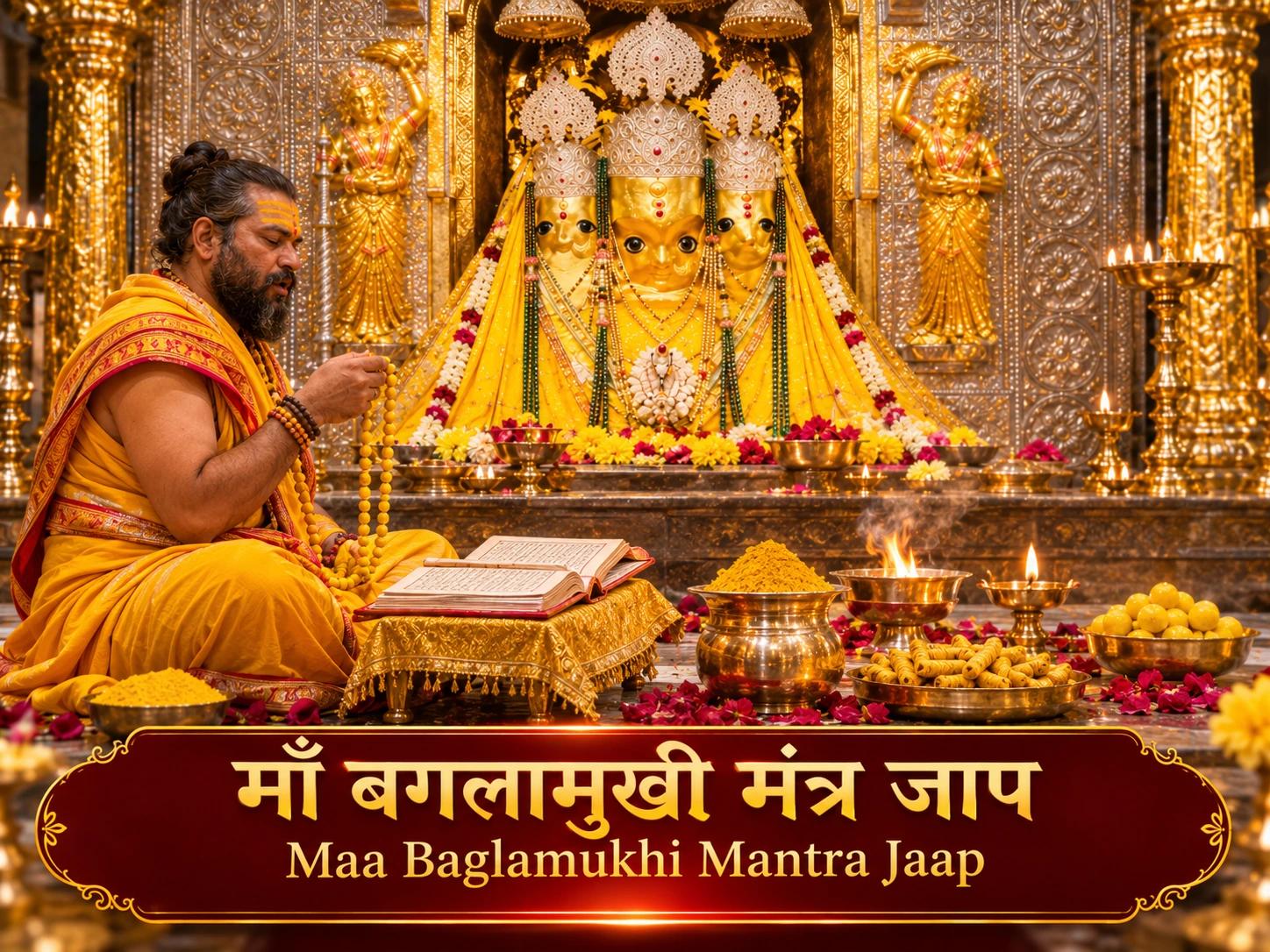
When a Prayer Becomes a Practice
Some people come to Maa Baglamukhi with a question they cannot easily explain. A family matter may have stayed unresolved for months. Work may have become tense. Or the person may not be facing a crisis at all: they simply want to spend a little time in prayer without the noise of daily routines.
It is easy to assume that a meaningful ritual must look dramatic. A sacred fire, many materials, a long list of ceremonial steps. Mantra jaap offers a different picture. The centre of the practice is repetition: returning to a mantra or divine name with care. The surroundings may be simple, but the practice asks for patience. A person who has never done jaap before should be able to understand that much without needing a dictionary of religious terms.
At Nalkheda, devotees visit the temple of Maa Baglamukhi, revered within Shakta traditions. If you are exploring a mantra-jaap arrangement connected to Her worship, the most useful starting point is not a promise about what will happen afterward. It is understanding what will actually be recited, who will guide the observance, whether you may participate and what has been agreed before any payment.
What Does “Mantra Jaap” Mean?
Mantra refers to a sacred utterance, formula or name used in worship. Jaap means repeating it as a devotional practice. People may associate the practice with audible recitation, quiet speech or inward remembrance; the method depends on the tradition and the guidance being followed.
A mala is a string of prayer beads sometimes used to keep count. The beads help the practitioner follow the rhythm without constantly checking a clock or writing down every repetition. Counting is part of some practices, but it is not the whole purpose.
Imagine reading the same sentence while your attention is elsewhere. The words may be repeated, yet the moment can feel empty. Jaap invites a different kind of attention: you return to the prayer whenever your thoughts wander. This is a description of a devotional approach, not a medical claim about treating anxiety or changing the brain.
Clear audible pronunciation; useful for beginners to establish steady rhythm and clear diction.
Whispered repetition where lips move softly; traditional quiet practice focused on inner composure.
Silent inward remembrance without lip movement; regarded in many traditions as deep contemplative focus.
Maa Baglamukhi & the Devotional Symbolism of Stillness
Maa Baglamukhi is known in Shakta worship and is popularly associated with stambhana, often described as restraint or stilling. A crude description turns that into a promise of stopping enemies, legal opponents or other people. That is not a responsible way to talk to someone who may already be distressed.
There is a gentler, more useful way to approach the symbolism. When words are being exchanged in anger, restraint matters. When the mind rushes from one worry to another, pausing before speaking matters. Devotees may understand the worship as an appeal for courage, clarity, steadiness and protection according to their beliefs. Those meanings belong to faith and religious interpretation; they do not prove that a chant can control someone else's actions.
You do not have to arrive with an “enemy problem” to enquire about this worship. A person may simply wish to honour the Goddess, participate in a family sankalp or learn the difference between an ordinary prayer and a more extensive observance.
The Place Matters — But So Does Accuracy
The Maa Baglamukhi temple at Nalkheda is located in Agar Malwa district, Madhya Pradesh, near the Lakhundar River. The district administration describes the temple as a place visited by devotees and Shakta practitioners. That is a useful and verifiable starting point for someone planning a visit.
What it does not tell us is whether a particular jaap will take place inside the main temple, in an associated prayer space or under a separate private arrangement. It does not establish that a specific number of repetitions is approved by the temple administration. Before travelling, ask where the service is actually conducted and who is responsible for coordinating it. “Near the temple” and “officially organized by the temple” are not the same claim.
If the arrangement is offered by an independent service coordinator, that relationship should be stated openly. No devotee should discover the difference only after arriving.
Maa Baglamukhi Temple on Lakhundar River, Agar Malwa, MP
Independent coordination & priest guidance; not an official temple claim
Why Someone May Enquire About Baglamukhi Mantra Jaap
Different devotees bring different intentions to sacred recitation. Here are five common devotional scenarios:
Devotees wishing to mark an occasion with quiet prayer. There is no requirement to present a crisis to justify devotion.
Praying for patience and composure during disputes. Where threats or harassment are real, legal and safety help are essential.
Creating a quiet, intentional pause. Prayer can accompany preparation, but never replaces studying or hard work.
Distinguishing standard jaap scopes from the extensive Sawa Lakh Anushthan, based on agreed schedule rather than sales adjectives.
Asking whether absent family members may be included in the sankalp. Discussed honestly without assuming live streams or courier prasad.
Think of a family sitting together before an important decision. Calls are being made; everyone is worried. Choosing to spend time in prayer creates a shared moment of seriousness and reflection. Yet the practical work remains: a lawyer still matters in a legal dispute, a doctor in an illness, and clear communication at work. Prayer belongs alongside those responsibilities without replacing them.
(Hypothetical illustration, not a testimonial or miracle claim)
Sankalp, Mala & Recitation Counts: Three Common Sources of Confusion
1. Sankalp: Clarifying Intention, Protecting Privacy
A sankalp is the intention or resolve associated with an observance. Personal details such as name and gotra may be requested for an agreed prayer. Do not send sensitive family information or identity cards to an unknown phone number simply because a website asks for it.
2. Mala: A Counting Aid, Not an Outcome Guarantee
A mala is a counting aid. Prayer beads may be made from different materials; turmeric beads are popularly associated with yellow-themed devotional practice, but the choice should follow the actual tradition and guidance. If a particular mala is proposed, ask why and whether it is included.
3. Recitation Counts: Scope of Work, Not Fixed Packages
Recitation count is a scope-of-work question. You may see 11,000, 24,000 or 36,000 recitations promoted online. Do not assume these are universal mandates or approved options at Nalkheda. Ask for the proposed count, number of practitioners, daily schedule, and method of recording completion.
What Can Happen During a Guided Jaap Arrangement?
The exact sequence must be confirmed by the practitioner, but a devotee can reasonably expect a conversation about intention, method and practical arrangements before the observance begins. The guide may discuss the tradition followed, the meaning of sankalp, whether the devotee joins recitation or listens, and what happens when the agreed practice is complete.
The article should not publish a universal “seven mandatory steps” recipe or a secret mantra under the guise of education. Traditions differ, and certain practices may require instruction or initiation. It is enough for a public page to explain the kinds of decisions the devotee must make.
How Mantra Jaap Differs from Other Approved Rituals
| Approved Ritual | Core Focus | Primary Devotional Intent | Key Distinction |
|---|---|---|---|
| Maa Baglamukhi Mantra Jaap (This Page) | Sustained repetition of sacred name or mantra with beads | Devotional focus, inner composure, speech clarity | Fire offering not automatic; quiet personal practice |
| Maa Baglamukhi Puja & Special Archana | Sixteen-offering worship (Shodashopachara) & stotra recital | Family welfare, gratitude & temple sanctum presence | Devotional offerings rather than extended bead repetition |
| Maa Baglamukhi Havan | Fire offerings with sacred wood, ghee & herbal samagri | Household purification & community fire prayer | Fire-centric ritual; not automatically part of plain jaap |
| Sawa Lakh Mantra Anushthan | Extended 125,000 recitation scope across multiple days | Major life milestones & extensive dedicated sadhana | Extensive observance; do not automatically upsell plain jaap |
If your enquiry centres specifically on legal dispute anxiety, consult the Court Case Victory Puja page. For general interpersonal opposition, see Shatru Badha Nivaran Puja; neither should be approached as a weapon or guaranteed victory.
Can Mantra Jaap Be Performed at Home?
Many Hindu devotional traditions include personal repetition of divine names or prayers at home. However, specialist mantras and initiatory practices can carry lineage-specific guidance. A first-time devotee should not assume that every mantra circulating on social media is suitable for unsupervised use or that a specific count is compulsory.
For an accessible starting point, ask a trusted knowledgeable teacher about ordinary prayer and how it differs from a guided or initiated observance. The purpose of this page is to explain a service and its context, not to issue a personal religious prescription.
A sense of having made time for devotion, deeper understanding of tradition, and reassurance from asking clear questions. These are personal experiences, not measurable commercial guarantees.
What Should You Prepare Before Making an Enquiry?
Start with your own questions. Ask these 6 practical questions before agreeing to any service:
Tradition & Practitioner
Which tradition is followed and who will guide the recitation?
Recitation Count & Schedule
What is the proposed count and daily session duration?
Exact Location & Setting
Will it be in the sanctum perimeter or an associated prayer hall?
Participation Rules
Can the devotee sit and recite, or is it conducted on their behalf?
Itemized Cost Transparency
What is the transparent breakdown of dakshina, materials and receipts?
Statutory Fee Verification
If an official fee is claimed, verify current proof and proper receipts.
A Clear Way to Begin
You need not choose a recitation count, priest tier or expensive package before speaking with someone. Start with the simplest question: What does this Mantra Jaap arrangement actually include, and is it right for what I want to do?
TIRTH YATRA is an independent information and enquiry platform.
Researched Inquiries & Frequently Asked Questions
It is a devotional observance centred on repeating a mantra or sacred name associated with Maa Baglamukhi. Jaap is not the same as fire offerings, and a service advertised under this name should disclose its actual recitation scope and guidance. The specific mantra, method and practitioner arrangements need confirmation rather than assumptions from a generic description.
Experiences Shared by Devotees
Authentic reflections shared by devotees who performed or participated in Maa Baglamukhi Mantra Jaap.
Be the First Devotee to Share Your Experience
No reviews have been published for this ritual yet. TIRTH YATRA strictly shows genuine user submissions and never manufactures ratings.
Agamic Sources & Related Offerings
Plan Your Sacred Ceremony with Verified Acharyas
Receive traditional guidance from verified Nalkheda purohits. Clarify auspicious muhurta, samagri, and participation arrangements with complete transparency.